 Skip to content
How to Recognize Overthinking and Break Free from Mental Loops
Have you ever replayed a conversation in your head long after it ended?
Maybe you found yourself lying awake at 2:00 a.m., wondering if you said the wrong thing. Or perhaps you’ve spent hours analyzing a mistake, trying to figure out what you “should have done differently.” Maybe you’re worrying about a decision you haven’t made yet, imagining every possible outcome.
If so, you’re not alone.
Most of us think a lot. The problem isn’t thinking. The problem is when thinking stops being helpful and starts becoming a loop.
As a therapist, one of the most common things I hear people say is, “I just can’t stop thinking about it.” What they’re describing is often something called rumination, getting stuck in repetitive mental loops that feel productive but rarely lead to solutions.
The tricky part? Rumination can disguise itself as problem-solving. In fact, research suggests that repetitive negative thinking can increase anxiety and emotional distress while making it harder to solve problems effectively (Ehring & Watkins, 2008; Nolen-Hoeksema et al., 2008).

When Thinking Helps and When It Doesn't
Not all thinking is created equal.
Sometimes thinking helps us make decisions, solve problems, and learn from our experiences. Other times, we end up mentally spinning our wheels.
Here’s a simple way to tell the difference:
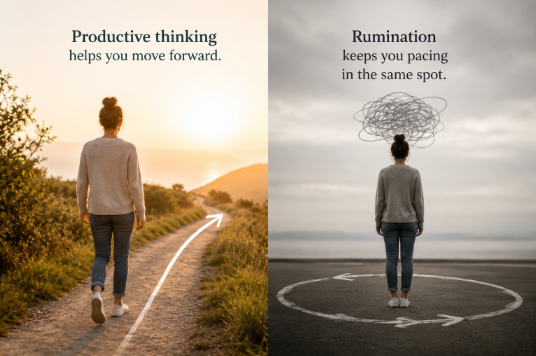
Productive thinking tends to:
- Lead to solutions or decisions
- Be focused on what can be done next
- Create clarity
- Result in action
Rumination tends to:
- Go around in circles
- Revisit the same issue repeatedly
- Focus on why something happened
- Leave you feeling more stuck, not less
The "Movie Replay" Problem
One of my favorite ways to explain rumination is through the “movie replay” metaphor.
Imagine your mind is replaying the same scene from a movie over and over again. Each time it plays, you’re hoping you’ll discover something new or change the ending somehow.
But the scene never changes.
You replay the conversation.
You replay the mistake.
You replay the argument.
You replay the decision.
By the tenth replay, you’re exhausted—but no closer to a solution.
Many people don’t realize they’re caught in this pattern because it feels like they’re doing something useful. In reality, they’re often just watching the same movie again and again.
The Question That Changes Everything
The next time you find yourself caught in a mental spiral, try asking:
“What is my mind doing right now?”
Not what am I thinking? But what is my mind doing?
Is it:
- Replaying?
- Analyzing?
- Predicting?
- Second-guessing?
- Reviewing?
This small shift can be surprisingly powerful. Instead of getting pulled into the content of the thought, you begin noticing the process itself.
It’s like stepping out of the movie and into the projection booth.
Is This Thought Helping Me?
Many people spend a lot of time trying to determine whether their thoughts are true.
A different question may be more useful: “Is this thought helping me?”
For example:
If you’ve spent an hour thinking about a disagreement with a friend, has that hour brought you closer to resolving it? If you’ve replayed an embarrassing moment twenty times, have you learned anything new? If you’ve worried about a future event all week, are you actually more prepared? Sometimes the answer is yes. Often, the answer is no.
Research has found that the impact of repetitive thinking depends less on how much we think and more on whether that thinking leads to insight, action, and problem-solving, or keeps us stuck in a cycle of mental reviewing (Watkins, 2008).
A thought can be true and still not be helpful to engage with repeatedly.
The “New Information” Test
Here’s a simple exercise I often recommend.
When you notice yourself overthinking, ask:
- Have I learned anything new in the last ten minutes?
- Am I generating new insights?
- Or am I repeating the same thoughts?
Rumination rarely produces new information.
It simply repackages the same information in slightly different ways.
If your mind has been saying the same thing for the last hour, that’s often a sign you’ve moved from reflection into rumination.
Common Triggers for Overthinking
Certain situations tend to pull us into mental loops more than others.
Some common triggers include:
- Conflict with a partner or family member
- Parenting worries
- Health concerns
- Work stress
- Uncertainty
- Rejection
- Perfectionism
- Fear of making mistakes
If you’re someone who likes certainty, control, or getting things “right,” uncertainty can feel especially uncomfortable.
The mind often responds by thinking harder.
Unfortunately, more thinking doesn’t always create more certainty.
Are You Problem-Solving or Problem-Soaking?
This is another distinction I love.
Problem-solving leads to action. Problem-soaking keeps us emotionally submerged in the problem.
A helpful question to ask yourself is:
“What action has come from all this thinking?”
If your thinking has helped you create a plan, make a decision, or take a step forward, great.
If not, you may be soaking in the problem rather than solving it.
Why We Keep Doing It
Here’s something important: rumination usually has good intentions.
Your mind is often trying to:
- Prevent future mistakes
- Keep you safe
- Prepare for danger
- Create certainty
- Gain control
- Understand what happened
In other words, your brain is trying to help. The problem is that it sometimes gets stuck using the same strategy long after it has stopped working.

Redirecting Attention
Many people try to think their way out of overthinking. That rarely works. Instead, try gently shifting your attention. Look around the room and notice five things you can see. Feel your feet on the floor. Take a slow breath. Listen for sounds around you. Notice what happens to the mental loop when your attention moves elsewhere.
You may discover something important: you don’t have to control every thought that enters your mind. You can choose where your attention goes.
The Hamster Wheel Effect
I often tell clients that mental activity and progress are not the same thing. A hamster wheel creates a lot of movement. It just doesn’t go anywhere.
The next time you find yourself exhausted from thinking, ask:
“Is this creating progress, or just movement?”
The answer may tell you everything you need to know.
Give Your Worries a Time and Place
If you’re someone who worries constantly, try setting aside 15 to 20 minutes each day as designated problem-solving time.
During that time:
- Write down concerns
- Brainstorm solutions
- Make decisions
- Create action steps
Outside of that window, remind yourself:
“I’ve already scheduled time to think about this.”
It may feel strange at first, but many people find it helps reduce all-day mental clutter
A Final Thought
The goal isn’t to stop thinking. Thinking is part of being human.
The goal is to become more aware of when thinking helps and when it simply keeps you stuck.
When you learn to recognize the difference, you can spend less time trapped in mental loops and more time engaged in the life happening right in front of you.

References
Ehring, T., & Watkins, E. R. (2008). Repetitive negative thinking as a transdiagnostic process. International Journal of Cognitive Therapy, 1(3), 192–205.
Nolen-Hoeksema, S., Wisco, B. E., & Lyubomirsky, S. (2008). Rethinking Rumination. Perspectives on Psychological Science, 3(5), 400–424.
Watkins, E. R. (2008). Constructive and Unconstructive Repetitive Thought. Psychological Bulletin, 134(2), 163–206.
Bell, I. H., et al. (2022). The effect of psychological treatment on repetitive negative thinking in youth: A systematic review and meta-analysis. Clinical Psychology Review, 97, 102200.
Li, Y., et al. (2024). A systematic review of the effects of rumination-focused cognitive behavioral therapy (RFCBT). Frontiers in Psychology, 15, 1447207.


