 Skip to content
Over-Functioning, Hormones, and the Midlife Brain
A number of years ago, in my early 40s (and yes, I realize I’m dating myself here), something began to shift.
Nothing dramatic. I was still working. Still parenting. Still managing life. From the outside, I looked steady — capable, productive, reliable.
But internally, something felt different.
I began waking in the middle of the night — not occasionally, but consistently. Wide awake at 2:17 a.m., as if my brain had received an urgent memo. I experienced sudden waves of heat that made no situational sense. My mood would dip unexpectedly — not major depression, but a heavy, flat overwhelm that felt disproportionate. My stress tolerance felt thinner. My focus required more effort. My libido shifted quietly.
And I did not yet have language for it. I was not falling apart. I was not incapable. I was no less competent. But something was recalibrating. Only years later did I understand that I was likely experiencing early perimenopause.

When Over-Functioning Is More Than Personality
Many midlife women assume these changes are stress, burnout, or personal weakness. But for high-functioning women in particular, over-functioning during this season is often not simply psychological. It is neuroendocrine. Relational. Identity-based.
As estrogen and progesterone levels begin to shift during perimenopause, the brain has to adjust. These hormones do much more than regulate periods. They influence sleep patterns, mood stability, stress response, focus, and even motivation. When levels fluctuate, the nervous system can become more sensitive. The nervous system is the body’s control center for stress, focus, and emotional balance. It includes the brain, spinal cord, and nerves, and it regulates how we respond to internal and external challenges. You may feel wired at night but exhausted during the day. You may notice that small stressors feel bigger than they used to. You may find yourself thinking more, worrying more, or trying harder to stay on top of everything.
The 2 A.M. Wake-Up Call
Middle-of-the-night awakenings are one of the most commonly reported midlife symptoms. Hormonal fluctuations can increase sensitivity in the stress-response system. Subtle cortisol shifts may interrupt sleep cycles.
Once awake, cognitive loops often begin: Why am I awake? I have too much to do tomorrow. Something must be wrong. Within minutes, physiology turns into anxiety. Understanding the biological component can reduce the tendency to be hard on yourself and soften the urgency that often follows.
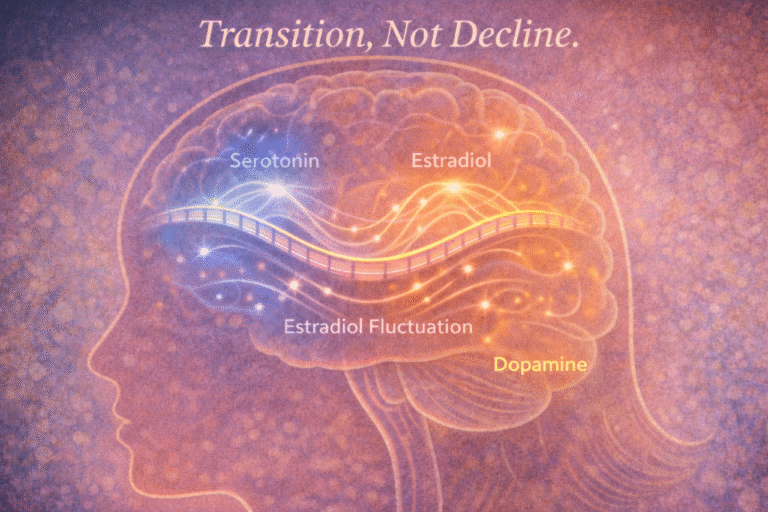
The Midlife Brain: Transition, Not Decline
Estradiol interacts directly with serotonin and dopamine—two key chemical messengers in the brain. Serotonin helps stabilize mood and support sleep. Dopamine helps with motivation, focus, and drive. Research suggests that fluctuations during perimenopause can temporarily affect working memory, mood buffering, and stress resilience. This does not signal inevitable cognitive decline. It signals transition. The difficulty arises not from the shift itself, but from expecting oneself to operate exactly as before—with identical energy, sleep stability, and emotional bandwidth. Midlife calls for adjustment, not judgment.
The Quiet Identity Disruption
For decades, many high-capacity women have been the reliable one, the steady one, the productive one—the person everyone else depends on. I certainly was. In my early 40s, when I began waking up at the same hour, night after night, I didn’t slow down. I tightened up. I organized more. I double-checked everything. I told myself I just needed to “manage stress better.” From the outside, I was still performing well. Inside, I felt less steady than I had in years.
When midlife introduces unpredictability, many women respond to these changes the only way they know how: by pushing through. They work harder. They plan more. They take on extra responsibility and try to control what they can. Over-functioning becomes a way to manage the uncertainty happening inside and a strategy to preserve one’s identity. But there is a problem with this strategy. The more you push, the more your stress hormones increase. Higher stress can worsen sleep disruption, mood swings, and brain fog. The effort to hold everything together can actually make the nervous system more overloaded.
In other words, the solution that worked in your 30s may not work the same way in your 40s and 50s. Midlife often asks for a different kind of strength—one rooted less in effort and more in awareness, adjustment, and care.
The Hidden Grief and Emerging Wisdom
There is also an emotional layer to this season. Many women quietly grieve changes they did not expect. There can be grief for effortless sleep. Grief for the sharp focus that once came easily. Grief for steady moods. Grief for a libido that felt more predictable. These losses are often subtle, but they are real.
But alongside that grief, something else often emerges: clarity. Many women begin asking deeper questions about sustainability, boundaries, meaning, and pace. What actually matters now? What am I carrying that no longer belongs to me? These are not signs of unraveling. They are signs of evolution.
Moving Toward Midlife-Resilience
Resilience in midlife is not about pushing through symptoms or returning to a previous version of oneself. For a long time, I thought that was the goal—to get my old energy back, to sleep like I used to, to feel as sharp and steady as I did in my 30s. I treated the changes as problems to fix.
What I eventually learned—both personally and professionally—is that midlife asks something different of us. It asks for understanding before action.
It involves learning how your brain and body are changing and responding with care instead of criticism. It means protecting sleep as if it were non-negotiable medicine. It means reducing cognitive overload instead of glorifying busyness. It means setting boundaries that support recovery, even when that feels unfamiliar or uncomfortable.

For me, that looked like saying no more often. It meant building white space into my calendar. It meant acknowledging that waking in the middle of the night was not a sign that I was “too anxious” but part of a hormonal transition. It meant allowing myself to be in process rather than polished.
It also means expanding identity beyond achievement. Many of us have built our worth around what we produce, manage, or hold together. Midlife gently—but persistently—invites us to ask deeper questions:
Who am I if I am not constantly performing?
What matters now?
What pace feels sustainable?
That questioning can feel destabilizing at first. But it is also deeply liberating.
Practicing self-compassion during this season isn’t letting yourself off the hook—it’s learning how to work smarter with your body. When your inner voice softens, your stress level often softens too. When you stop being hard on yourself for being tired, foggy, or more emotional than usual, your nervous system has a chance to settle.
I noticed this in my own midlife transition. The more I told myself to “get it together,” the worse I felt. But when I began speaking to myself the way I speak to my clients or loved ones—with patience and steadiness—I felt more grounded. Not because I was doing more, but because I had stopped fighting my own physiology. That shift didn’t make me less capable. It made me more resilient.

References
- Schmidt, P. J., et al. (2015). The role of estradiol in mood disorders. American Journal of Psychiatry.
- Thurston, R. C., & Joffe, H. (2011). Vasomotor symptoms and menopause. Journal of Clinical Endocrinology & Metabolism.
- McEwen, B. S. (2017). Neurobiological and systemic effects of chronic stress. Chronic Stress.
Suggested Books for Further Reading
- The Menopause Brain by Lisa Mosconi, PhD
- The New Menopause by Mary Claire Haver, MD
- Estrogen Matters by Avrum Bluming, MD & Carol Tavris, PhD
- You Are Not Broken by Kelly Casperson, MD


